CG-BENCH / STATE ASSESSMENT
Was the coffee shop open?
Loading the recorded trace…
EVIDENCE IN THE CATALOG
Paper · Figure 2 ↗PLANNER-SELECTED SKILLS
What this trace shows
 ASSEMBLE
EVIDENCE-GROUNDED VIDEO REASONING · ARXIV 2026
ASSEMBLE
1University of Maryland, College Park2Google
THE IDEA
A correct answer.
A traceable reason.
Macro answer accuracyvs. 58.3% for Gemini-2.5-Pro
Macro Grounded accuracyvs. Gemini-2.5-Pro
A shared post-trained reader235B teacher · 23 atomic skills
Three benchmarks · Shared precomputed evidence catalogs · Paper-reported results. Comparison details ↓
01 / OVERVIEW
Long-video questions can depend on clues scattered across many scenes. Answer accuracy alone does not tell us whether a model used the right moments.
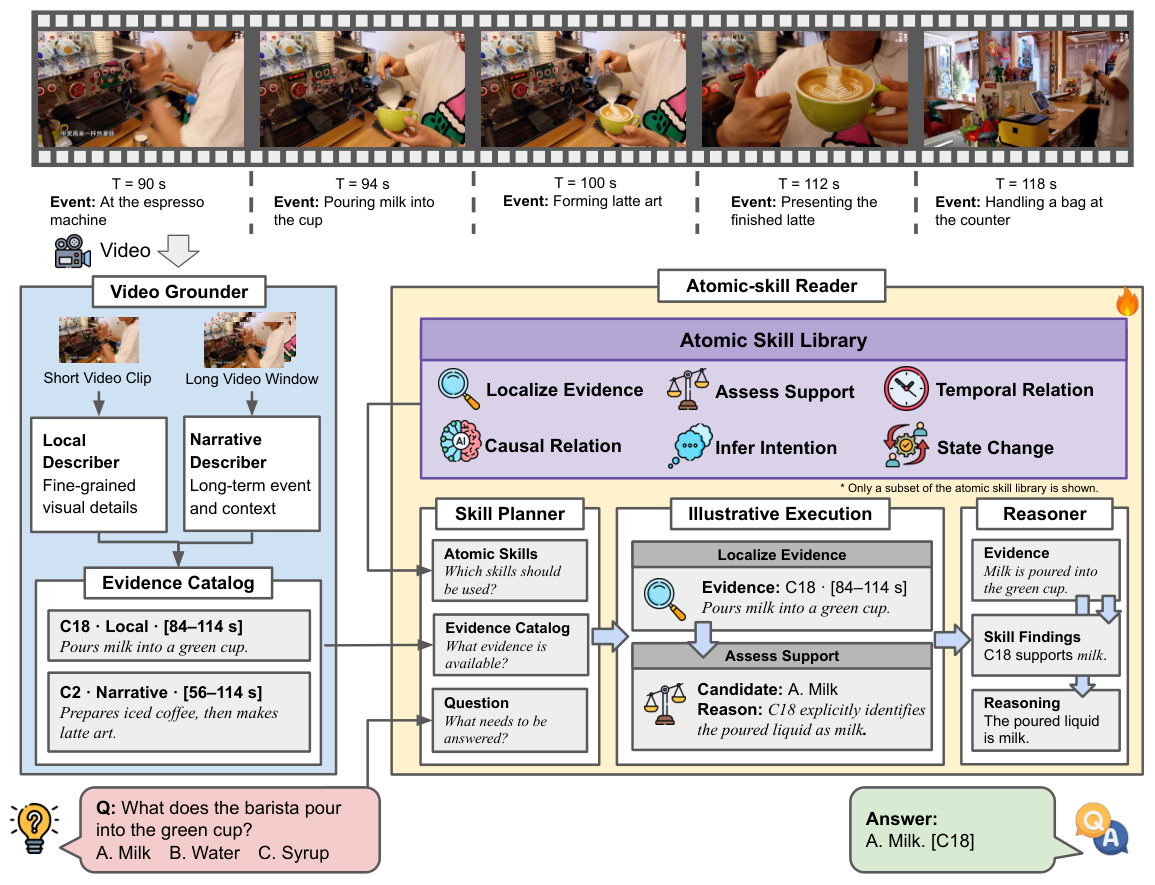
ASSEMBLE makes evidence use explicit. A video grounder builds a reusable catalog of timestamped observations. A shared reader composes question-specific atomic skills, records intermediate findings, and links its answer to supporting catalog entries.
Grounding-aware post-training encourages answers that are both correct and aligned with the annotated video evidence.
A SHORT INTRODUCTION
English synthetic narration · On-screen captions · Four cases from the paper · Original frames, skill paths, and a failure analysis.
02 / EXAMPLES FROM THE PAPER
Follow the original video frames, timestamped evidence, and recorded skill outputs. Switch between examples to see why different questions call for different operations.
CG-BENCH / STATE ASSESSMENT
Loading the recorded trace…
EVIDENCE IN THE CATALOG
Paper · Figure 2 ↗Frames and trace summaries adapted from Figures 2, 3, 5, 6, 8, and 9 of Wu et al. (2026), CC BY 4.0. These are recorded examples, not live model runs. All support scores are model-generated.
03 / THE FRAMEWORK
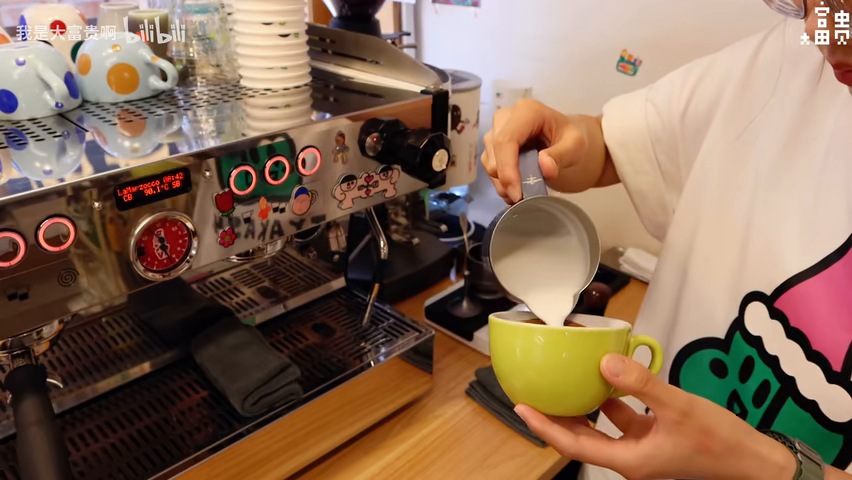
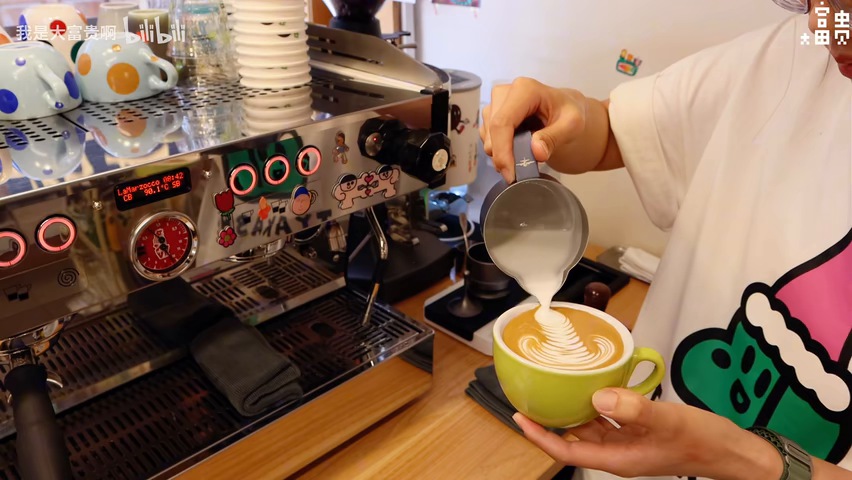
C18 · 84–114 sMilk poured into a green cup.
01 / BUILD THE CATALOG
Local observations and, when available, longer-range narratives become textual entries with IDs and source intervals. The catalog is built independently of the question and reused across queries.
The video grounder combines local descriptions and longer-range narratives. In the Figure 1 illustration, C18 [84–114 s] records milk being poured into a green cup, while C2 [56–114 s] describes preparing iced coffee and latte art. The shared reader selects skills, applies them to the evidence, and integrates the findings. Support assessments are model-generated.
GROUNDING-AWARE POST-TRAINING
Citation alignment is rewarded only for a correct answer. Training uses question–catalog responses; structured skill traces provide context at inference time.
04 / MAIN RESULTS
All methods below are evaluated as readers of the same default evidence catalog within each benchmark. These are catalog-reader comparisons, not end-to-end raw-video comparisons.
What counts as Grounded? A correct answer plus citation precision ≥ 0.5 against annotated evidence spans. It is an overlap-based measure; it does not require complete temporal coverage.
Read the gains in context. Macro Grounded accuracy is 25.38% vs. 18.72% for Gemini-2.5-Pro: a 6.66 percentage-point difference, rounded to 6.7 pp. Stricter temporal-alignment metrics are mixed.
| Method | Video-Holmes | VRBench | CG-Bench | |||
|---|---|---|---|---|---|---|
| Accuracy | Grounded | Accuracy | Grounded | Accuracy | Grounded | |
SAME READER, SAME CALL BUDGET
Dynamic skills yield the highest Grounded point estimate on all three benchmarks in the inference control study. The reader checkpoint and evidence catalog are held fixed.
Inference controls · Table 3 ↗Macro Grounded accuracy (%)
Arithmetic means of the three reported benchmark point estimates.
05 / THE ATOMIC SKILL LIBRARY
Each skill defines arguments, instructions, structured outputs, and evidence references. The same reader performs the operations.
Source: Appendix B, Table 5. The bank lists available operations, not individual causal contributions.
06 / EXPLORE FURTHER
Method, experiments, ablations, and full qualitative traces.
arXiv:2609.3246602 ↗Successful cases, failure cases, and a citation-coverage gap.
Appendix I03 ↓A visual introduction with English narration and captions.
Download MP4Catalog quality limits the available evidence. Reader-generated support assessments are not independent verification or hard execution gates. A correct answer can still have incomplete temporal coverage; the paper also reports failures from insufficient evidence and unsupported hypotheses.
@misc{wu2026assemble,
  title={ASSEMBLE: Atomic Skills for Evidence-Grounded Video Reasoning},
  author={Xiyang Wu and Zongxia Li and Shengxin Zhang and Zhichao Liu and Dinesh Manocha},
  year={2026},
  eprint={2609.32466},
  archivePrefix={arXiv},
  primaryClass={cs.MM},
  url={https://arxiv.org/abs/2609.32466}
}